Weird scenes inside the gold mine
"Perhaps in his choice for Fed chairman, President Trump should have nominated David Copperfield instead."

https://www.pricevaluepartners.com/weird-scenes-inside-the-gold-mine/
“The stock market is the only market where things go on sale and all the customers run out of the store.”
Cullen Roche.
Not just the stock market, either. It also holds for the markets in gold and silver, too. We don’t usually comment on day-to-day price developments as a) our interpretation of events may well be wrong, and b) by the time we’ve shared them with readers, the markets have moved on in any case. But the magnitude of the moves in the prices of gold and silver on 30th January warrant some further analysis.
The financial media were quick to report, firstly, the apparent end to the precious metals ‘bubble’ and, secondly, to blame the new nominee for Fed chairman, Kevin Warsh, for its climactic explosion. Well, as the noted law enforcer ‘Dirty’ Harry Callahan once opined, opinions are like assholes – everybody’s got one.
We should also perhaps allude to the fact that there is now more than one market for gold (and especially silver): there is a paper-based market in the Anglosphere, where banksters can take advantage of proprietary information asymmetry (including knowledge of where traders have placed stop loss orders) to manipulate prices and, in some instances, trigger cascades of forced selling such as we recently saw in the precious metals futures markets. And then there is a physical market in Asia (and elsewhere) where you can trade the real thing. Capital goes to where it is most respected. The premium attached to metals prices in Shanghai, for example, versus those in the West may yet become permanent.
For those sympathetic to technical analysis, we present three charts.
The first shows how a four-decade-long rally in US T-bonds came to an abrupt end roughly four years ago. This suggests that bond investors for the foreseeable future have their work cut out. It also suggests that other conventional asset classes (i.e. growth stocks) will have their work cut out, too.
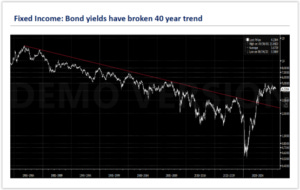
Source: Bloomberg LLP.
The second chart shows the biggest technical break-out of all time, namely that of commodities in the 1970s, which successfully broke up through a 100-year base.
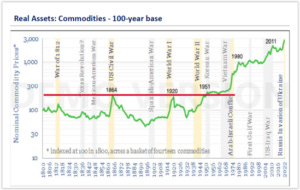
Reference to the 1970s is unusually instructive. That decade saw a monetary reset (Nixon’s gold shock of 1971), sundry foreign wars, an oil embargo, and pronounced stagflation (high inflation but with no attendant economic growth). In the 1970s, stocks were a disaster, bonds were a disaster – but commodities were the best performing asset class. The prices of both gold and silver in US dollar terms went up over 20 times. Perhaps history is repeating itself ?
Our third chart depicts the second biggest technical breakout of all time, namely that of silver, up through a 45-year duration ‘cup and handle’ formation at the end of 2025. As any systematic trend-follower will tell you, new highs are bullish – and new highs following a 45-year base formation are very bullish.
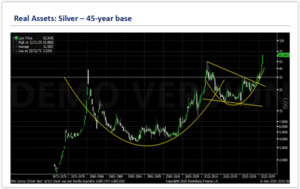
Source: Bloomberg LLP.
Clearly the price action of end-January 2026 inflicted a fair degree of technical damage on the dollar prices of gold and especially silver, but we are minded to conclude that nothing fundamentally has changed about the rationale for owning them. The world is still drowning in government debt. The official US national debt still fast approaches $39 trillion, growing at roughly $1 trillion every 100 days or so. Both US and UK debt to GDP ratios are well above 100% (and let’s not mention Japan). Perhaps in his choice for Fed chairman, President Trump should have nominated David Copperfield instead.
It’s important that we define terms. What, for example, is the definition of a kilogram ? We asked Grok, and here is its response:
“The scientific definition of the kilogram (kg) — the SI base unit of mass — is now (since May 20, 2019) based on fundamental constants of nature rather than a physical object. According to the official definition adopted by the General Conference on Weights and Measures (CGPM) and published by the International Bureau of Weights and Measures (BIPM):
“The kilogram, symbol kg, is the SI unit of mass.
“It is defined by taking the fixed numerical value of the Planck constant h to be 6.626 070 15 × 10⁻³⁴ when expressed in the unit J s (joule second), which is equal to kg m² s⁻¹,
where the metre and the second are defined in terms of c (the speed of light in vacuum) and Δν_Cs (the hyperfine transition frequency of the caesium-133 atom), respectively.
“This means:
The value of Planck’s constant h is now exactly 6.626 070 15 × 10⁻³⁴ kg m² s⁻¹ (no measurement uncertainty).
The kilogram is effectively realized (measured in practice) using instruments such as the Kibble balance (which relates mechanical power to electrical power) or the X-ray crystal density method (using silicon spheres), both of which link macroscopic mass to the microscopic quantum world via h, the speed of light c, and the caesium frequency.
“This 2019 redefinition replaced the previous artefact-based definition (the mass of the International Prototype of the Kilogram, a platinum-iridium cylinder near Paris), which could slowly drift or become contaminated over time. The change ensures the kilogram is invariant, universal, and perfectly reproducible anywhere in the universe using the same laws of physics — without depending on a single precious object.”
So much for the kilogram. So what is a dollar ?
………….
As you may know, we also manage bespoke investment portfolios for private clients internationally. We would be delighted to help you too. Because of the current heightened market volatility we are offering a completely free financial review, with no strings attached, to see if our value-oriented approach might benefit your portfolio – with no obligation at all:
…………
Tim Price is co-manager of the VT Price Value Portfolio and author of ‘Investing through the Looking Glass: a rational guide to irrational financial markets’. You can access a full archive of these weekly investment commentaries here. You can listen to our regular ‘State of the Markets’ podcasts, with Paul Rodriguez of ThinkTrading.com, here. Email us: info@pricevaluepartners.com.
Price Value Partners manage investment portfolios for private clients. We also manage the VT Price Value Portfolio, an unconstrained global fund investing in Benjamin Graham-style value stocks and real assets, and also in systematic trend-following funds.
Hahaha brilliant ending, Tim.
the promise of a serial liar?